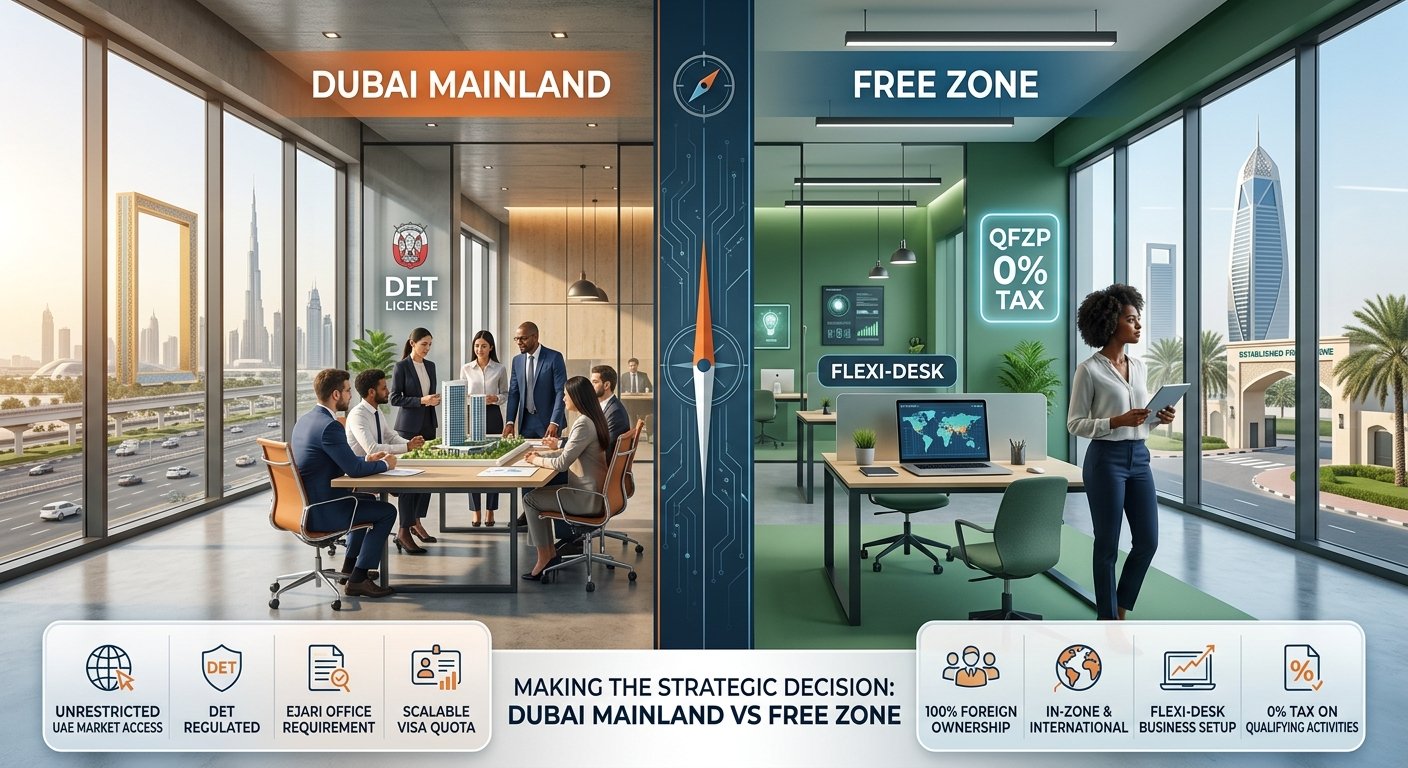
Dubai Mainland vs. Free Zone: Cost, Ownership, and Tax Comparison
Choosing between a Dubai Mainland entity and a Free Zone setup is the single most critical decision you will make when establishing a business in the United Arab Emirates. While both jurisdictions offer world-class infrastructure and access to a booming economy, selecting the wrong legal structure can limit your market reach, trigger unexpected tax exposure, or lead to unnecessary operational overhead.
The decision surrounding Dubai mainland vs freezone setups often comes down to four major friction points: regulatory scope, upfront and recurring costs, tax optimization, and long-term scaling strategy. Navigating these variables requires an objective look at legal frameworks, office requirements, and local trading capabilities.
This guide breaks down the real costs, legal nuances, and strategic advantages of both jurisdictions so you can select the right jurisdiction for your business model.
1. Ownership & Legal Structure
Historically, foreign investors looking to set up on the Mainland required a UAE national sponsor holding 51% of the company's shares. Following major amendments to the UAE Commercial Companies Law (Federal Decree-Law No. 32 of 2021), foreign entrepreneurs can now achieve 100% foreign ownership UAE status for over 1,000 commercial and industrial activities on the Mainland without needing a local partner.
+-----------------------------------------------------------------------------------+
| OWNERSHIP STRUCTURE COMPARISON |
+------------------------------------------+----------------------------------------+
| DUBAI MAINLAND | FREE ZONE |
| • Up to 100% Foreign Ownership | • 100% Foreign Ownership Guaranteed |
| • Regulated by Dubai DET | • Regulated by Specific Authority |
| • Direct UAE local market access | • Restricted local market access |
+------------------------------------------+----------------------------------------+
Dubai Mainland (DET Jurisdiction)
Mainland entities are registered directly through the Dubai Department of Economy and Tourism (DET). They allow complete ownership in most trading, manufacturing, and service sectors. A local service agent (LSA) is generally only required for specific professional services to handle government administrative relations, without taking equity or voting rights.
Free Zone Entities
Free Zones are independent jurisdiction hubs operated by their own regulatory authorities (e.g., DMCC, IFZA, Meydan, DIEZ). They have always guaranteed 100% foreign ownership, simple capital repatriation, and zero currency restrictions. However, your entity remains governed strictly within the geographic and legal boundaries of that specific zone.
2. Business Scope & Market Access
Your business model dictates which jurisdiction can legally support your revenue streams.
MAINLAND SETUP:
[Company] ------------ Direct Commercial Activity ------------> [Local UAE Market & Government Contracts]
FREE ZONE SETUP:
[Company] ------------ Trade / Services ------------> [International Markets / In-Zone Trade]
|
+---- Local Market Distribution ----> Requires Local Distributor / Onshore Agent
Direct Local Market Access vs. In-Zone Restrictions
- Dubai Mainland: Offers unrestricted commercial freedom. A Mainland license lets you trade directly with consumers anywhere across the UAE, open retail outlets, bid for lucrative UAE government contracts, and deliver B2B or B2C services locally without intermediaries.
- Free Zone: Free Zone licenses restrict you to trading within that specific zone or internationally. To distribute physical goods directly into the local UAE mainland market, a Free Zone company must engage a licensed local distributor or establish an onshore branch, which incurs an additional 5% UAE customs duty.
3. Real Cost Breakdown: Upfront Fees & Office Overheads
Calculating the total cost of company formation requires looking beyond initial headline package prices. You must factor in mandatory office leases, government fees, visa allocation quotas, and recurring license renewals.
+-----------------------------------------------------------------------------------+
| LICENSE & RENT STRUCTURE |
+------------------------------------------+----------------------------------------+
| DUBAI MAINLAND | FREE ZONE |
| • Base License: AED 15,000 - 25,000 | • Base Package: AED 12,000 - 20,000 |
| • Ejari Required: AED 10,000 - 35,000+ | • Flexi-Desk: Included / Low Cost |
| • High Visa Quota (based on sq ft) | • Capped Visa Allocations (1 to 6) |
+------------------------------------------+----------------------------------------+
License Fees & Government Charges
The base DET license cost for a Mainland commercial or professional entity typically ranges between AED 15,000 and AED 25,000, excluding mandatory office lease costs and variable market fees (usually calculated at 5% of your annual commercial lease value).
Free Zone entry packages appear cheaper on paper, often starting from AED 12,000 to AED 20,000, but these packages usually cover only basic activities and minimal or zero visa allocations.
Office Space & Workspace Obligations
- Mainland Ejari: Mainland entities must hold a physical office space registered under an official Ejari contract. A physical address adds lease costs (averaging AED 10,000 to AED 35,000+ annually for small office setups), but it enables larger visa quotas tied directly to your square footage.
- Free Zone Flexi-Desk Options: Early-stage startups and remote consultants frequently opt for a flexi-desk business setup within a Free Zone. Flexi-desks provide a shared workspace address at low cost, though they limit the total number of employment visas your company can issue (typically 1 to 3 visas per package).
4. Corporate Tax, VAT & Operational Compliance
Since the introduction of the UAE Federal Corporate Tax framework, both Mainland and Free Zone companies must submit annual corporate tax filings, regardless of profit levels or turnover.
┌────────────────────────────────────────┐
│ UAE CORPORATE TAX │
└───────────────────┬────────────────────┘
│
┌─────────────────────┴─────────────────────┐
▼ ▼
┌───────────────────┐ ┌───────────────────┐
│ DUBAI MAINLAND │ │ FREE ZONE │
└─────────┬─────────┘ └─────────┬─────────┘
│ │
┌─────────┴─────────┐ ┌─────────┴─────────┐
│ Standard Tax Rate │ │ Tax Classification│
└─────────┬─────────┘ └─────────┬─────────┘
│ │
┌─────────┴─────────┐ ┌─────────────────┴─────────────────┐
│ 0% up to 375k │ ▼ ▼
│ AED Profit │ ┌───────────────────┐ ┌───────────────────┐
│ │ │ QUALIFYING FREE │ │ NON-QUALIFYING │
│ 9% above 375k │ │ ZONE PERSON │ │ INCOME │
│ AED Profit │ └─────────┬─────────┘ └─────────┬─────────┘
└───────────────────┘ │ │
┌─────────┴─────────┐ ┌─────────┴─────────┐
│ 0% on Qualifying │ │ Standard 9% │
│ Income │ │ Tax Rate │
└───────────────────┘ └───────────────────┘
Standard Corporate Tax vs. Qualifying Free Zone Status
- Mainland Corporate Tax: Applies a standard 9% rate on net taxable profits exceeding AED 375,000. Profits up to AED 375,000 are taxed at 0% to support SME growth.
- Free Zone Corporate Tax: Free Zone entities can access a 0% Corporate Tax rate only if they meet the criteria for a Qualifying Free Zone Person (QFZP). This requires generating income purely from free zone qualifying activities (e.g., manufacturing, re-export trading, headquarter services, fund management) and maintaining adequate substance within the zone. Non-qualifying commercial income earned by a Free Zone business is subject to the standard 9% rate.
Streamlined Setup Opportunities
For service-oriented businesses needing immediate market deployment on the Mainland, fast-track registration systems like an instant commercial license Dubai option allow eligible activities to secure a DET license within hours. This setup defers the immediate requirement for a physical office lease (Ejari) for the first operational year.
Quick Visual Comparison
| Factor | Dubai Mainland (DET) | Free Zone Jurisdiction |
| Foreign Ownership | Up to 100% foreign ownership across 1,000+ commercial activities | Guaranteed 100% foreign ownership |
| Market Access | Unrestricted access to local UAE, retail, and government contracts | Limited to international trading and within the designated zone |
| Office Space Requirement | Physical office lease (Ejari) required (deferred yr 1 with instant license) | Flexible options: flexi-desk, virtual space, or physical office |
| Visa Allocation Capacity | Scalable quota based on total square footage of leased space | Restricted visa caps (typically 1–6 visas tied to package tier) |
| Corporate Tax Treatment | 0% up to AED 375k profit; 9% on profits exceeding AED 375k | 0% on qualifying activities (QFZP); 9% on non-qualifying income |
| Local Banking & Credibility | Broader bank selection; simpler corporate bank account opening | Standard bank approval process; stricter KYC on remote entities |
Strategic Decision Framework: Which Setup Fits Your Business?
STARTING A UAE BUSINESS
│
┌─────────────────────┴─────────────────────┐
▼ ▼
Targeting UAE Local Market? Pure Global / Remote Model?
│ │
┌─────────┴─────────┐ ┌─────────┴─────────┐
▼ ▼ ▼ ▼
YES NO YES NO
│ │ │ │
▼ ▼ ▼ ▼
[DUBAI MAINLAND] Consider Scale [FREE ZONE SETUP] Evaluate Onshore Needs
• Local Retail & Physical Need • International Trade • Consult Expert
• On-Site B2B • Remote Services • Compare Long-term
• Gov Contracts • Low Headcount Costs
Select a Dubai Mainland Setup If:
- You plan to establish physical retail stores, restaurants, salons, or showrooms anywhere in Dubai.
- Your core revenue model relies on providing B2B or B2C services directly to onshore companies and local residents.
- You intend to bid on government tenders or work as a primary contractor for large UAE infrastructure projects.
- You require an expansive workforce and need a large visa quota tied to physical office space.
Select a Free Zone Setup If:
- Your operations are centered on international e-commerce, global SaaS, remote consulting, or holding investments.
- You can structure operations to capitalize on 0% corporate tax on qualifying activities.
- You require a lean launch utilizing a flexi-desk business setup to keep initial capital expenditure low.
- You do not require direct local retail distribution within the mainland UAE.
Form Your UAE Entity with Ezee Consultancy
Selecting the right legal framework forms the foundation of your company's growth in the UAE. Misinterpreting activity codes, failing to account for physical office requirements, or misjudging tax qualifying status can lead to unexpected expenses and administrative delays.
At Ezee Consultancy, our specialists manage the entire corporate structuring process end-to-end:
- Clear jurisdiction evaluations tailored to your operational strategy.
- Detailed cost estimates with transparent fee breakdowns for DET and Free Zone options.
- Full assistance with activity selection, licensing, Ejari lease registration, and residency visa processing.
- Corporate bank account opening support and corporate tax structuring guidance.
Ready to streamline your business launch?
Contact Ezee Consultancy today for a personalized cost calculation and free consultation.