
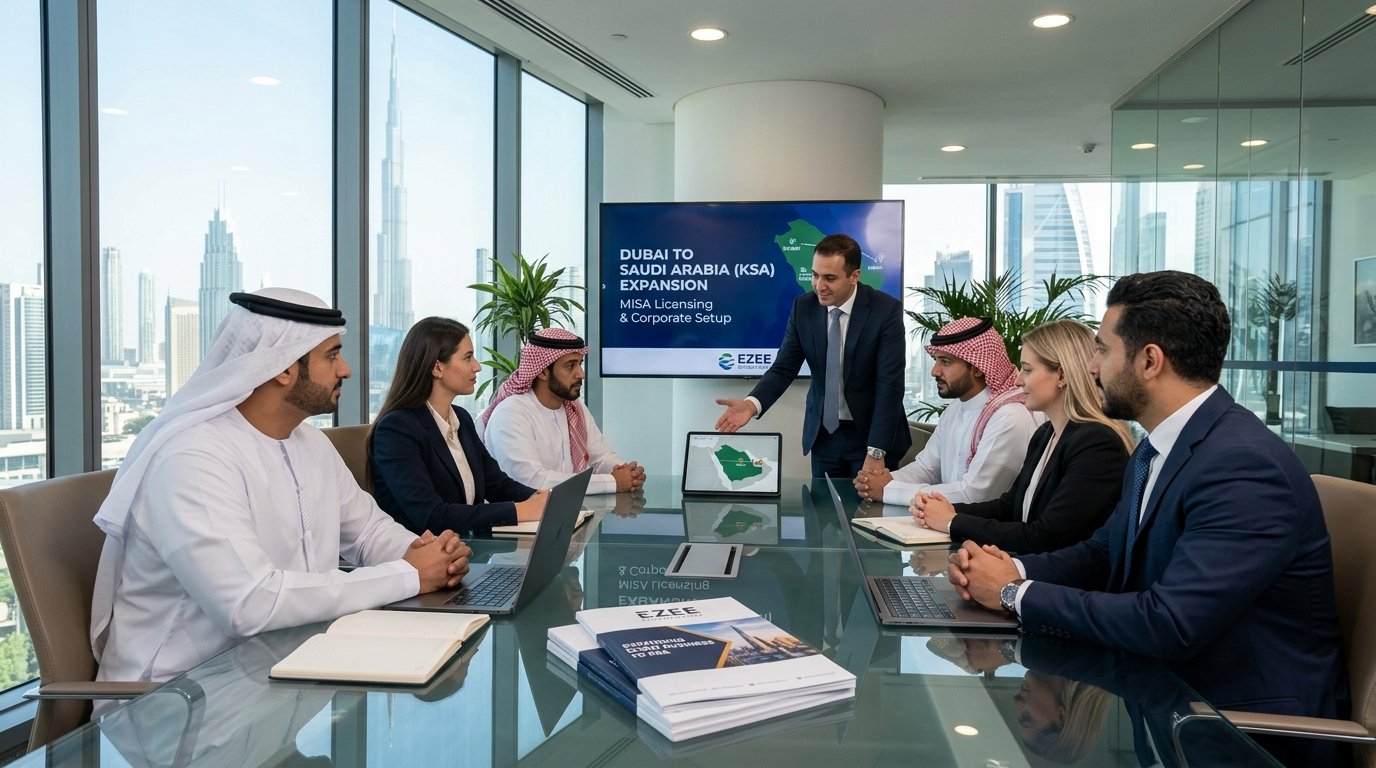
Establishing a presence in the Kingdom of Saudi Arabia (KSA) is the primary growth trajectory for UAE-based companies seeking to capture Vision 2030 commercial opportunities. However, enterprise leaders face substantial operational friction when navigating differing cross-border GCC expansion regulations, capital requirements, and foreign investment approvals between the two markets.
To successfully expand a business from Dubai to Saudi Arabia, company leadership must establish a compliant corporate vehicle under the Ministry of Investment (MISA), evaluate capital reserves, and align legal structures across both jurisdictions. This comprehensive guide details the precise regulatory frameworks, licensing pathways, compliance obligations, and operational strategies required to scale your enterprise seamlessly into KSA.
1. Regulatory Foundations: Foreign Investment & Legal Structures in KSA
Expanding into Saudi Arabia requires direct authorization from the Ministry of Investment of Saudi Arabia (MISA), which grants the primary foreign investment license required before local commercial registration.
Key Corporate Vehicles for Dubai Entities
- Foreign Branch Office: A direct legal extension of the existing Dubai entity. The branch operates under the parent company's name and corporate history, maintaining complete financial and legal alignment.
- Limited Liability Company (LLC / Subsidiary): A distinct legal entity established in KSA. It offers limited liability protection to the Dubai parent entity and allows flexible ownership distribution among regional partners.
- Regional Headquarters (RHQ) Program: Designed for multinational groups operating across the Middle East. Establishing an RHQ in Riyadh provides corporate tax incentives, visa exemptions, and exclusive eligibility to contract with Saudi government entities.
2. Navigating the MISA License Setup KSA Process
Securing a MISA license setup KSA approval forms the mandatory first milestone of your Saudi market entry strategy. The MISA framework categorizes licenses based on commercial activities, each carrying specific minimum capital thresholds and regulatory mandates.
+------------------------+ +------------------------+ +------------------------+
| 1. Dubai Parent Entity | ---> | 2. MISA Investment | ---> | 3. Saudi Commercial |
| Document Legalization | | Approval & Licensing | | Registration (CR) |
+------------------------+ +------------------------+ +------------------------+
|
+------------------------+ +------------------------+ v
| 6. Final Commercial | <--- | 5. Bank Account Setup | <--- +------------------------+
| Operational Status | | & Capital Deposit | | 4. General Organization |
+------------------------+ +------------------------+ | for Social Insurance |
+------------------------+
Essential Steps for Licensing Approval
- Document Legalization: Attest corporate documents (Dubai Trade License, Memorandum of Association, Certificate of Incumbency) at the UAE Ministry of Foreign Affairs (MOFA) and the Saudi Embassy in the UAE.
- MISA Application Submission: Submit commercial background, audited financial statements for the previous fiscal year, and operational scope details directly through the MISA portal.
- Saudi Trade License Setup: Obtain the Commercial Registration (CR) from the Ministry of Commerce upon receiving MISA approval.
- Labor & Social Insurance Enrolment: Register with the Ministry of Human Resources and Social Development (MHRSD) and the General Organization for Social Insurance (GOSI) to begin local hiring under Saudization quotas.
3. Comparing Operational Frameworks: Dubai vs. Saudi Arabia
Operating a dual setup Dubai Saudi Arabia framework requires understanding distinct jurisdictional differences in corporate governance, taxation, and labor regulations.
| Evaluation Variable | Dubai (UAE) Framework | Saudi Arabia (KSA) Framework |
| Primary Foreign Regulator | DET (Mainland) / Respective Free Zone Authorities | Ministry of Investment (MISA) |
| Minimum Capital Requirement | Minimal for most activities (no minimum for standard LLCs) | Varies by activity (e.g., SAR 26M for 100% foreign trading; nil for RHQ) |
| Corporate Tax Rate | 9% on taxable profits exceeding AED 375,000 | 20% on net foreign share capital profits |
| Local Workforce Mandates | Emiratisation quotas based on firm size/category | Saudization (Nitaqat) system based on sector and firm headcount |
| Value Added Tax (VAT) | 5% standard rate | 15% standard rate |
4. Financial & Compliance Obligations: Tax, Banking, and Saudization
Cross-border expansion impacts enterprise financial planning and tax exposures.
- Corporate Tax & Zakat: KSA imposes a 20% Corporate Income Tax on the share of profits attributable to non-Saudi/non-GCC foreign partners. Saudi/GCC national equity shares are subject to Zakat (2.5% on net worth/assessable base).
- Transfer Pricing: Transactions between your Dubai entity and Saudi branch/subsidiary must follow arm's-length principles and comply with ZATCA (Zakat, Tax and Customs Authority) transfer pricing documentation rules.
- Nitaqat (Saudization): Saudi labor law mandates minimum percentages of Saudi nationals in your workforce. Compliance levels dictate your ability to issue new work visas and process operational renewals.
5. Strategic Recommendation Framework: Selecting Your Expansion Model
Select your entry vehicle based on operational goals and market engagement depth:
- B2B Enterprise Services & Tech Services: Opt for a MISA Services License via a Foreign Branch or LLC. This setup offers low capital requirements and swift execution for consulting, IT, and specialized services.
- Government Contracting & Enterprise Regional Hubs: Leverage the Regional Headquarters (RHQ) Program to centralize regional oversight in KSA, gain eligibility for public tenders, and access operational tax benefits.
- Wholesale & Retail Trading: Execute a Saudi trade license setup for commercial activities. Choose between partnering with a local Saudi shareholder or satisfying MISA capital investments for 100% foreign ownership.
Scale Your Enterprise Across the GCC with Ezee Consultancy
Expanding your corporate operations from Dubai to Saudi Arabia requires precise execution across regulatory bodies, legal documentation, and tax authorities. Ezee Consultancy provides full-scope advisory, legal attestation, MISA licensing, and operational incorporation services designed for Middle Eastern enterprise expansion.
Contact our business setup experts today at Ezee Consultancy to receive a tailored expansion roadmap, cost breakdown, and free strategic consultation.